.png)
Rosenberg and His Modern Masters: The Theft and Recovery of Influential Art Dealer Paul Rosenberg's Collection
- Monuments Men and Women Fnd

- May 31
- 6 min read
The Rosenbergs, Alexandre (d. 1913) accompanied by his sons Léonce (1979-1947) and Paul (1881-1959), had been an established name in the art world since the late nineteenth century. Alexandre had dealt in antiquities before shifting to Impressionist and Post-Impressionist works of art near the turn of the century. He educated his sons and fostered their professional development prior to his retirement, entrusting the continuation of the family's dealings to the brothers. Their partnership was brief, as Léonce and Paul had diverging dealing interests which led to them establishing their own, separate galleries in Paris.
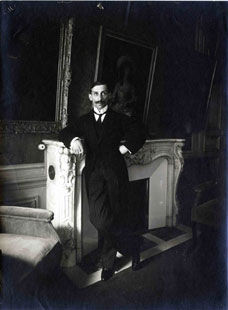
Paul Rosenberg resided and operated his business from 21, rue La Boétie in the eighth arrondissement, the street colloquially known as the "French Florence" as it was the epicenter for the latest works entering the French art market. He opened a branch of his gallery in London in the mid-1930s in partnership with his brother-in-law, Jacques Helft. By this time, his inventory had become a comprehensive selection of works from the previous century through to the avant-garde, including those by his neighbor and friend, Pablo Picasso.
Rosenberg's influence spanned continents, as he cultivated a respected career from his many connections and dealings with artists, collectors, and art professionals abroad, particularly those in Europe and the United States. As one of the most influential dealers of French works from the nineteenth and twentieth centuries in the interwar period, his celebrity all but insured he would become a primary target of the systemic theft of French collections by the Nazis.
The Third Reich began its Western Campaign on May 10, 1940, invading Belgium, the Netherlands, Luxembourg, and France in the offensive attack. The following month, France capitulated and signed an armistice that divided its territory into two: zone occupée under the occupation and administration of the Germans to the north and west, and zone libre which was unoccupied by the Germans but under the administration of the collaborative Vichy regime to the south. Paris was in the zone of German occupation and its cultural treasures were an immediate target.
One June 30, 1940, Hitler authorized German civil and military authorities to seize French cultural objects for "safeguarding." Joachim von Ribbentrop, the Reich Minister of Foreign Affairs, assigned the responsibility to Heinrich Otto Abetz, the newly appointed German ambassador to Vichy France, who enthusiastically began executing at the confiscation of French property from his command at the German embassy on rue de Lille, Paris, with assistance from German occupational agencies. His efforts would quickly be superseded by the Einsatzstab Reichsleiter Rosenberg (ERR), which became the primary Nazi organization engaged in looting cultural property in France.
By the time Abetz ordered the Galerie Paul Rosenberg sequestered and its contents seized at the beginning of the occupation, Rosenberg and his family were no longer in France. Having sensed the imminent threat of war, Rosenberg had shuttered his Parisian gallery months prior and sent portions of his collection abroad, with some works transferred to his London branch and others selected for inclusion in special exhibitions. Works that remained in France were dispersed in several locations. Some works remained in Paris, others were stored in Tours, registered under Paul's chauffeur. One hundred sixty-two paintings were transported to Libourne to a vault in the National Bank of Commerce and Industry (Banque Nationale pur le Commerce et l'Industrie or BNCI). Approximately seventy-five works accompanied Rosenberg and his family to a temporary residence, Le Castel, in Floirac, near Bordeaux. Rosenberg, his wife and children, and other family members remained there until June 1940, when they departed Floirac for the France-Spain border. However, Rosenberg's son, Alexandre, and two of his male cousins did not cross the border into Spain, instead of sailing to England, where they joined Charles de Gaulle's Free French forces. The remaining family members traveled through Spain on the Portugal, where they obtained visas and sailed onto the United States. On September 20, 1940, Rosenberg and his family arrived in New York.

Just days prior to the Rosenbergs' arrival in New York, German soldiers and police entered the Floirac residence and carried away the crated works to the German embassy in Paris. Rosenberg had limited contact with his family and friends that remained in France. The fate of the works he had left behind in France remained uncertain to him until March 1941 when he received a letter from his secretary: "There's nothing left, nothing, nothing, nothing." It was referencing the seizures at 21, rue La Boétie, which in May 1941 had been requisitioned and converted to the Institute for the Study of Jewish Questions (Institut d'Étude des Questions Juives or IEQJ), and Le Castel in Floirac. Authorities discovered Rosenberg's BNCI vault in Libourne in April 1941. The ERR removed the 162 works that September, transporting them to the Jeu de Paume museum in Paris and to Reichsmarschall Hermann Göring. The works that had been hidden in Tours were never discovered by the German or French authorities. Ultimately, the Nazis confiscated some four hundred works from Rosenberg.
Rosenberg resumed dealing from New York, in 1941, operating from a new gallery space on East 57th Street, which opened to great fanfare. Thirteen years later he moved to East 79th Street, where he remained until his death in 1959. He was able to reassemble some of his pre-war collection and inventory in his final years, having personally returned to France to recover works, and receiving restitutions from Allies after war. Alexandre, who had returned to France during the war with the French Second Armored Division as a lieutenant, intercepted the final train of French looted art bound for Germany in the Paris suburbs. Aboard were some of his father's works.
Alexandre joined his father at his New York gallery upon his release from the military in 1946 and assumed its directorship when his father died. The family's gallery and restitution efforts continued under Alexandre's leadership until his death in 1987. More recently, Paul Rosenberg's grandchildren have carried on the family history and tradition: Marianne Rosenberg established the Rosenberg & Co. Gallery in 2015, and Anne Sinclair's memoir My Grandfather's Gallery: A Family Memoir of Art and War was published in English in 2014 (the French edition had been published two years prior). After
decades of restitution efforts, an estimated sixty works remain missing from the Rosenberg collection.

Most Wanted: The Degas Pastel
Portrait of Mlle. Gabrielle Diot was one of the treasured works that accompanied Paul Rosenberg to his residence in Floirac, France. In September 1940, Rosenberg's chauffeur, who had been entrusted with the temporary care and planned transported of the works of art at Floirac, was confronted by German authorities and two informants who had conspired with the Nazis to reveal the location of Rosenberg's collection in exchange for 10 percent of its total value in paintings. The pastel was carried away to the German embassy and later processed by the ERR before entering the Parisian art market.
The Rosenbergs became aware of the pastel's existence by chance in 1987. Hamburg art dealer Mathias Hans, who brokered the sale of the pastel to a Swiss collector in 1974, was attempting to sell the pastel again. His refusal to reveal the identity of the current owner, coupled with legal hurdles, have thwarted the restitution of the work to the Rosenberg family.
"The Portrait of Mlle. Diot by Degas was one of my grandfather's most beloved works, and the Rosenberg Family has been seeking to recover the work for many years. The fact that the work has been located but the professor refuses to cooperate in any way in the rightful restitution of the work is a painful and frustrating reminder of how difficult these issues remain." - Marianne Rosenberg


Comments