.png)
Imprisonment and Expropriation: The Fate of Fritz Grünbaum and his Art Collection
- Monuments Men and Women Fnd

- May 31
- 4 min read
Fritz Grünbaum gave his final performance on New Year's Eve 1940. The terminally-ill, Jewish cabaret star was trying to bring what little joy he could to his fellow inmates in the Dachau concentration camp just days before his death. He died the following month, a tragic culmination of years of harassment, expropriation, and imprisonment by the Nazis.

Franz Friedrich "Fritz" Grünbaum (1880-1941) was born in Brno, Moravia (today, the Czech Republic). After studying law in Vienna, he turned to performing and writing, with his career interrupted by his service in WWI. As his popularity grew upon his return to the stage in the 1920s, his performances became more political. Known for his clever wit and humor, Fritz openly mocked and criticized the National Socialists in the theaters of Berlin and Vienna until he was forced to end his performances in Germany and retreat to Austria due to the rise of the Nazi regime and Anti-Semitic legislation.
The Nazis annexed Austria into the Third Reich on March 12, 1938, in what was known as the Anschluss. Fritz, a Jew and outspoken political opponent of the Nazis, was no longer safe in Vienna. He attempted to flee east to Czechoslovakia with his wife, Elisabeth "Lilly" (née Herzl) during the invasion, but the two were apprehended at the border. The Gestapo subsequently arrested and imprisoned him in Vienna just days after his return. Lilly attempted in vain to have her husband released, going as far as to bribe local officials, but Fritz remained in Nazi custody and was deported to the Dachau concentration camp that June. He was briefly transferred to the Buchenwald concentration camp but returned to Dachau where he ultimately perished in January 1941.
Fritz appreciated not only the performing, but also the visual arts, amassing an impression collection in the interwar period. At its height, it contained over four hundred works of art and reflected his tastes for modern Austrian artists. He took a particular liking to works by Austrian Expressionist Egon Schiele– nearly one-fifth of his collection, eighty-one works, were by the artist.
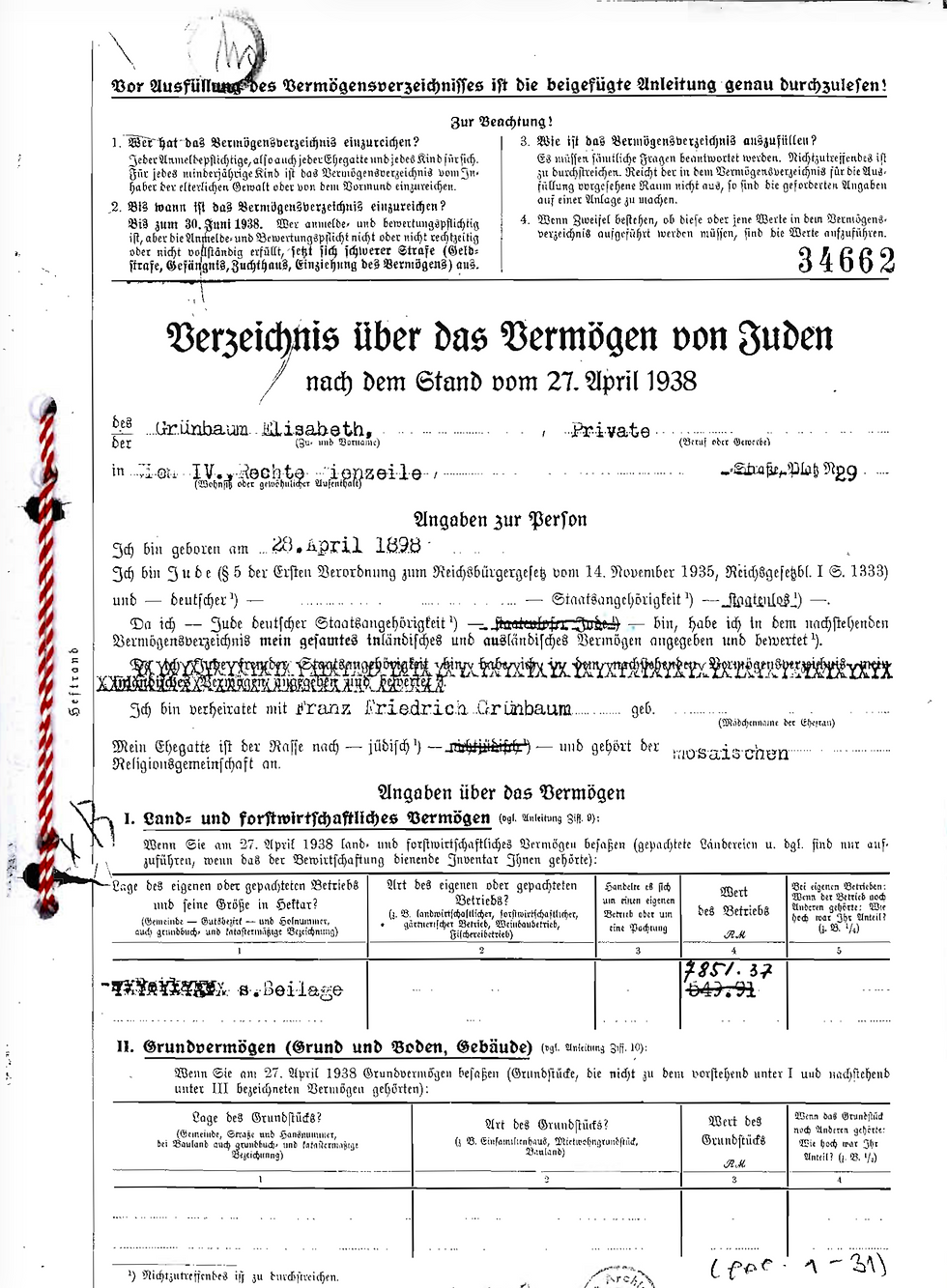
In late April 1938, the Nazis enacted the Decree for the Reporting of Jewish-Owned Property which required all Jews to register to assets valued at more than 5,000 RM (Reichsmark) with authorities. Lilly complied on the behalf of her husband, who was forced to assign power of attorney to his wife from Dachau, and the Grünbaum collection was inventoried and appraised that July by an art historian and Nazi official, Dr. Franz Keislinger. The collection was transferred to the Aryanized shipping company Schenker & Co., from the couple's residence, frozen, and then confiscated and Aryanized– the process by which confiscated Jewish assets are transferred to non-Jewish custody and a trustee appointed by the Nazis. In the case of the Grünbaum collection, the Aryan trustee was Dr. Ludwig Rochlitzer. Lilly reported in June 1939 that she had been forced to pay extortionate fees associated with the Nazi persecution. At the time of Fritz's death, she states in a property declaration that the art collection was no longer an asset and testified that there was no estate.
Lilly suffered a similar fate to that of her husband. She was evicted from her home before early 1939, forced into smaller accommodations before being apprehended by Nazi authorities and placed in a designated Jewish residence under Nazi supervision in Vienna– a deplorable arrangement comparable to Jewish ghettos. She was deported to Maly Trostinets extermination camp near Minsk, Belarus, on October 5, 1942, where she perished four days later, almost certainly by execution.
The exact details of the war-time fate of Fritz's collection after it was confiscated from Lilly by the Nazis are unknown. It is believed that it was mostly kept intact as almost eighty percent of it was sold by Swiss art dealer Eberhard Kornfeld in the 1950s. Controversy and mystery remain as how Kornfeld acquired so many Grünbaum works– Kornfeld's claim that he acquired them from Fritz's sister-in-law and Lilly's sister, Mathilde Lukacs, has been disproven.
Relatives of Fritz attempted to recover portions of the estate several years after WWII, inquiring of various agencies and authorities in Germany, the United States and Austria. Their efforts were hindered terribly by bureaucratic red tape, especially in Austria.
In more recent times, restitution and settlement efforts by the Grünbaum heirs have been met with frustration and success. In 2012, a US federal court ruled against the heirs after a seven-year battle over a Schiele in 1964. Yet, in 2014, two years after that final ruling, the heirs' rights were recognized when Christie's auctioned another Schiele work formerly in the Grünbaum collection pursuant to a settlement agreement.
It was a 2015 lawsuit by the heirs that became one of the first tests of the United States' Holocaust Expropriated Art Recovery (HEAR) Act, enacted in December 2016. In Reif, v. Nagy, the HEAR Act defeated London art dealer Richard Nagy's defense of laches, clearing the way for the court to decide that the transfer of the collection from Fritz to Lilly was involuntary and forced through coercion, therefore good title never passed from Fritz and any subsequent transfer invalid. The two works recovered by the heirs, Woman Hiding Her Face and Woman in a Black Pinafore, both by Schiele, are being held pending an auction at Christie's until Nagy has exhausted his appeals. In the meantime, representatives for the Grünbaum heirs continue to bring visibility to those works formerly of the collection that remain displaced in institutions and private hands through a dedicated website and blog.
The Foundation wishes to thank Raymond Dowd and Herbert Gruber for their contributions to his piece. For more information on the Grünbaum collection and the current restitution efforts of the heirs, please visit collectiongruenbaum.com. For those interested in submitting information concerning an existing restitution claim for cultural objects looted during the Nazi Era, please forward images and details to wwiiart@mmwf.org. The Foundation also encourages those individuals in possession of artworks or other cultural objects with suspected Nazi-era provenance to get in touch with us at the email address above.


Comments