.png)
Persecution and Provenance: The Search for the Missing Art Collection Belonging to a Prominent Canadian Gallerist Continues
- Monuments Men and Women Fnd

- Jun 2
- 7 min read

When Concordia University released roughly five thousand artworks onto the market for sale at the beginning of this century from the liquidated inventory of Dominion Gallery and its famous owner, the late Dr. Max Stern, an unexpected result occurred; artworks already circulating on the market were identified as property once belonging to Stern. With the details largely unknown at the time, this wasn't the first occasion that Stern's inventory had been liquidated. As consequence of Nazi persecution some sixty years later, Stern had been deprived of his livelihood and disposed of his art collection under duress.
Max Stern was born in München-Gladbac (now Mönchengladbach), Germany, in 1904. He was the youngest child and only son of Julius and Selma Stern. His father was a textile manufacturer who shifted his focus to art collecting and dealing and opened the Galerie Julius Stern in Düsseldorf in 1913, exposing a young Max to art and nurturing his interests. Stern studied at several universities and eventually earned a PhD in art history from Bonn University in 1928. After which, he promptly joined the gallery staff and assumed management shortly before his father's death. When Julius died in October 1934, Stern inherited the gallery–renaming it Gallery Stern– but never saw it thrive as it had been increasingly threatened by the rise of National Socialism and anti-Semitic culture in Germany since 1933.
That September, the Reichskulturkammer (Reich Chamber of Culture or RKK) was established with the sub-organization the Reichskammer der bildenden Künste (Reich Chamber of Fine Arts or RKdbK). When Stern applied for the compulsory membership into the RKdbK so he could continue dealing, he was denied admission in August 1935. By this time, Galerie Stern was forbidden from holding auctions and had turned to curating exhibitions in its spaces to sell artworks. With the decision from the RKdbK, Stern could no longer legally practice his profession in Germany and his Düsseldorf business was ordered to close and dissolve. Stern took advantage of a suspension of the order, attempting to save his business through a quasi-Aryanization scheme, but his requests were consistently rejected.
As Stern struggled with the authorities in Germany, his sister Hedwig Selbiger-Stern– who had been with Galerie Stern since 1920– immigrated to London with a selection of Old Master paintings. There, she founded West’s Galleries Limited with art historian Cornelis J.W. van de Wetering in early 1937, whereas Stern could continue his dealings in London, if ever needed.
By September 1937, the German authorities had had enough and issued the final closure order– albeit, ultimately with an extension date– stipulating that no further appeals from Stern would be entertained. By then, Stern had begun to surrender to their order and had sold the two buildings that had housed Galerie Stern. That November, his inventory of 228 artworks was placed for auction at the Mathias Lempertz auction house in Cologne. Those that didn't sell at Lempertz would have to be sold by Stern himself. The proceeds generated by the sale of property and assets were never utilized by Stern to start a new life in London, but rather returned to the Reich as compulsory payment. With the exception of his library, which he was able to ship to London, Stern and his mother's collection of artworks were mostly left in the stewardship of Joseph Roggendorf in Cologne, who owned a logistics company, and were prohibited from being exported from Germany. A few paintings remained with Lempertz.
Just before Christmas 1937, Stern departed Düsseldorf for Paris a defeated man. After several weeks in Paris with his other sister Gerda and then abroad in North America, Stern settled in London, joining Hedwig at the West's Galleries. The artworks left in Cologne were confiscated by the Gestapo, which had been well-informed of Stern's status by the RKdbK and were following his activities. Some were then handed to the lesser-known Hufschmidt auction house to be sold.
Stern's time at the West's Galleries was short lived. When Britain declared war on Germany in September 1939, he soon became an enemy alien and was detained in an internment camp on the Isle of Man. His internment was transferred to Canada, and after two years in custody he was released on the word of William Birks, who was associated with the Canadian National Committee on Refugees, and settled in Montreal.

In Montreal, Stern rebuilt his life by turning to the profession he know best, the commercial art trade. A new gallery had just opened, the Dominion Gallery of Fine Art, and its owner Rose Millman took a chance on hiring the German émigré. Within a year, Stern was managing the gallery; within six years, he had bought out Millman, shortened the name to just Dominion Gallery, and was well into transforming the Canadian art market and introducing a country to its own artistic merits. His support propelled living Canadian artists to new levels of appreciated and fame. Goodridge Roberts, Emily Carr, Jean-Philippe Dallaire, members of the Group of Seven– all worked with Stern. Many promising Canadian artists signed contracts with Dominion Gallery. A year prior to Stern owning the gallery, he married Iris Westerberg from Malmö, Sweden. She would be her husband's business partner for decades until her death in 1978.
As Stern was dealing into prominence in Canada in the late 1940s, he was also attempting to reclaim what he had lost in Germany by pursuing the restitution of his former collection. In addition to property and financial assets, he sought twenty paintings from his and his mother's collection and filed a claim with British occupational authorities in the European theater in December 1948. To ensure a thorough search of Western Germany, Canadian military authorities notified the Monuments Fine Arts and Archives (MFAA) offices in the US zone of occupation in March 1949, requested an investigation into the holdings of the collecting points. The details of that investigation, if it occurred, are unknown, and Stern did not recover any artworks through the assistance of the American MFAA. In addition to asking for assistance from military government agencies, Stern took out an advertisement in the German magazine Die Weltkunst featuring images of nine important artworks he was seeking.

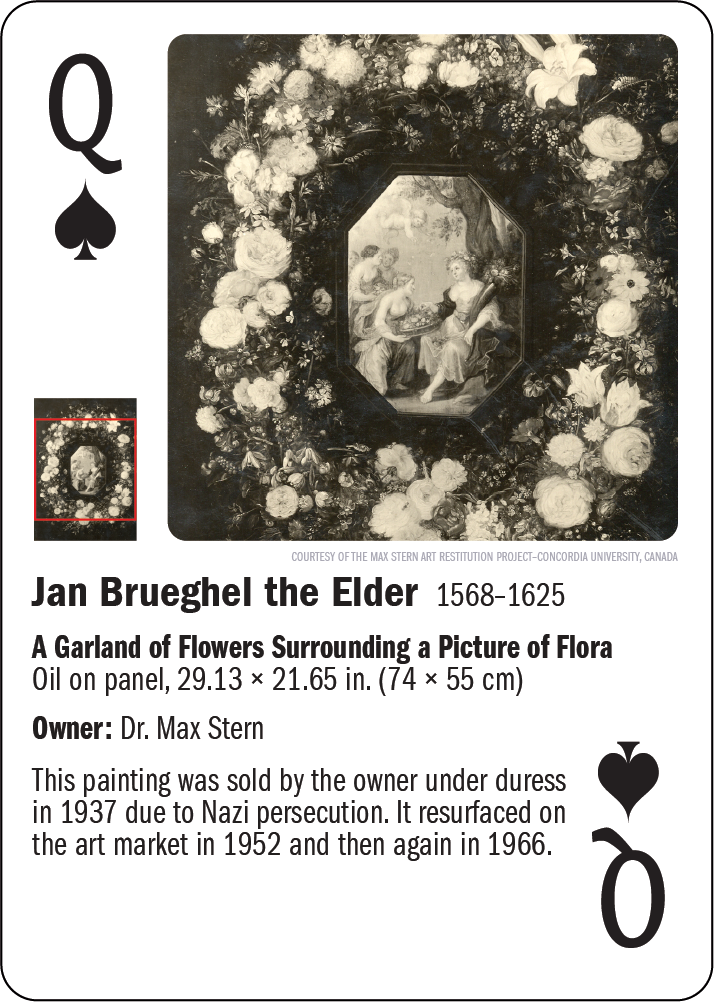
His restitution efforts immediately after the war were met with limited success. British authorities questioned Josef Roggendorf and discovered that he still had two Stern paintings, a work by Dirk Hals and another by Salomon van Ruysdael, in his possession. These artworks had never been confiscated by the Germans. Stern's ownership was quickly verified and the artworks were returned through Canadian authorities. Three artworks that had been delivered to the Städtische Kusthalle (Municipal Art Museum) Düsseldorf in 1939 on Nazi orders were lost. The museum had just been a repository for the Gestapo's seizures and had not kept track of the artworks that had been stored there. A handful of additional artworks were located in private German collections and settled through litigation in the 1950s. Stern was awarded monetary damages from the 1937 liquidation of his gallery inventory in the 1960s. The thirteen artworks which had been seized from Roggendorf's storage facility by the Gestapo and later sold were still missing.
Dr. Max Stern was a formidable figure in Canada's commercial art trade until his sudden death in 1987 while on a business trip to Paris. Shortly before his death, he received two notable honors, the Order of Canada in 1984 and an honorary doctorate from Concordia University in 1985. He and his wife had been generous benefactors to several academic and art institutions during their lifetimes, and upon his death he left the majority of his estate to three institutional beneficiaries: Concordia University, McGill University–both located in Montreal, Canada– and the Hebrew University of Jerusalem. Stern's archives were donated to the National Gallery of Canada when Dominion Gallery was closed in 2000.

Two years after the liquidation of Dominion Gallery's inventory and the revelation of Stern's lost artworks, the Max Stern Art Restitution Project (MSARP) was launched under the direction of Dr. Clarence Epstein with the support of Stern's three university beneficiaries. Tasked with continuing the restitution efforts Stern pushed himself after the war, the project takes a unique approach in recovering the missing artworks not only through legal channels, but their preferred method of reconciliation through nonlegal means. Simply put, the works under the belief that the restitution of these artworks originates from a moral obligation to do what's right. "Dr. Stern's heirs are major universities in Canada and Israel. We firmly believe that education is a critical component in the restitution process– whether as a means of presenting our case to those who possess looted art or for the general public that should better understand the ongoing research of the historic crime scene that was Germany in the Nazi Era," said Epstein.
The Project's first restitution came in 2006, and since then, twenty-three artworks have been recovered either through returns or settlement. The latest one was a German Rococo Revival painting returned in March 2021 with the assistance of Hargesheimer Auction House in Düsseldorf.
The Foundation wishes to thank Dr. Clarence Epstein and the MSARP team for their contributions towards this piece. The Stern collection is included on the Foundation's website listing of restitution claims. For those interested in submitting information concerning an existing restitution claim for cultural objects looted during the Nazi Era, please forward images and details to wwiiart@mmwf.org. The Foundation also encourages those individuals in possession of artworks or other cultural objects with suspected Nazi-Era provenance to contact us at the email address above.



Comments